IVSS How Projects Are Judged


IVSS: How Projects Are Judged (Rubrics)
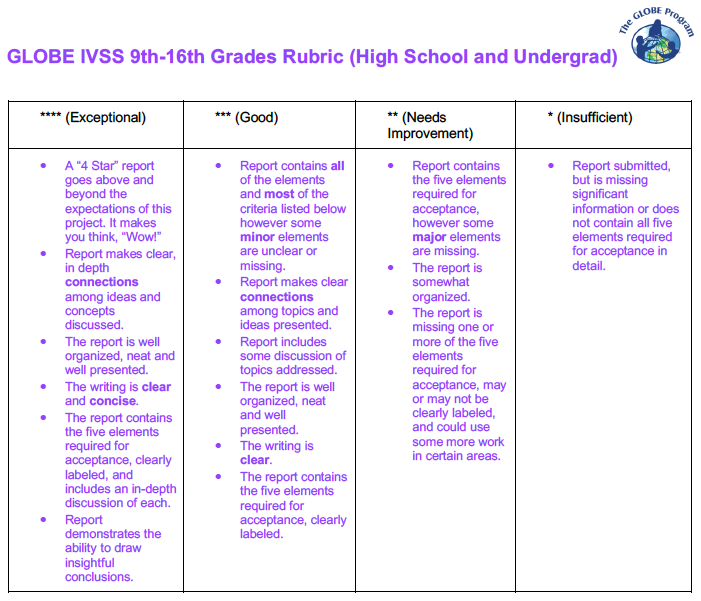
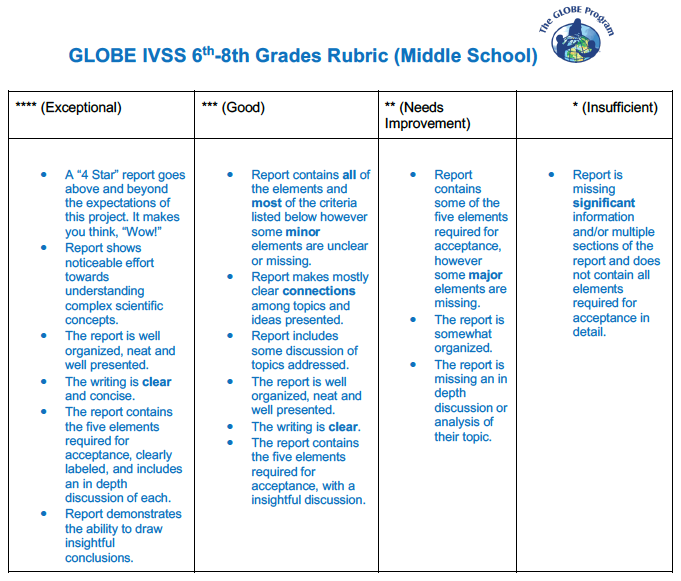
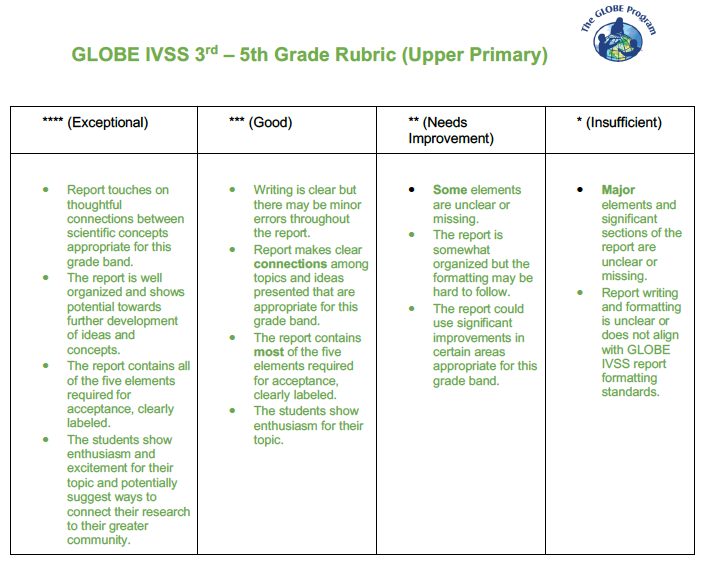
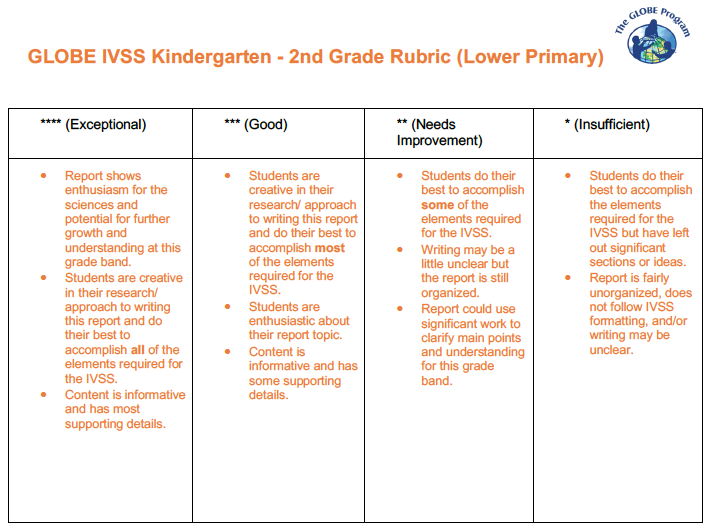
Rubrics for the past three symposia are listed below by grade level.
Search and review IVSS submitted projects from 2023.
2023
| Four Stars (Exceptional) | Three Stars (Good) | Two Stars (Needs Improvement) | One Star (Insufficient) |
|---|---|---|---|
|
|
|
|
Project elements and criteria for High School and Undergraduate, ages 14-18+
* required element
1. Title*
- Concise (less than 15 words)
- Summarizes paper’s content
2. Abstract*
- Concise (less than 300 words)
- Context of research
- Research questions
- Objectives set
- Brief methods description
- Results
- Conclusions
- Recommendations for a way forward
- Key words that emphasize key ideas in the paper (3-5 words)
3. Research Questions*
- Include why they are important and are of scientific interest
- Concern some aspect of Earth’s environment (local or global issue)
- Provide significant insight into both the topic of investigation and the research process
- Answering them requires an advanced understanding of the subject matter
- Require a thoughtful research plan
- Are answerable through scientific research appropriate to the scope of the report
4. Introduction & Review of Literature
- Thorough (250-500 words)
- Description of the problem
- State of the science
- Importance
- Community relevance
- Citations in text (at least 3-5 references, including one primary source in a peer-reviewed journal. Do not include wikis or Q&A sites such as answers.com.
- Tip: Check out the The Purdue "OWL" for guidance and resources
5. Research Methods*
- There is a direct link provided between the datasets and research question(s)
- Study site: A map and description of the study site. It should mention area of study, climatic characteristics and basic aspects of land cover
- Data collection: A description of GLOBE protocols used to answer the research question as well as where and how data was gathered in the field (sampling method: Where, how many samples were measured)
- Print screen of data entry in the Web page of GLOBE.
- Data analysis: Mention what kind of mathematical calculation was applied to analyze the data
- The data presented are sufficient to answer the research question(s)
6. Results
- Tables and graphics applying statistical analysis of data to show mean, dispersion, or grouping data.
- Data support the conclusions
- Print screen of GLOBE Visualization page
7. Discussion
- Interpretation of results
- Possible sources of error
- Comparison with similar studies
- Discuss whether results support the hypothesis or not, and why
8. Conclusion*
- Gives a thorough and insightful explanation as to how the conclusion was reached
- Put findings in context, why it's important/relevant, impact, with regard to the science
- What improvements in methods
- What follow-on research/actions to be taken, future protocols that could be added
- Impact of working with a project mentor
9. Bibliography/Citations
- Materials correctly cited
- GLOBE materials used
- Sources beyond those powered by GLOBE
| Four Stars (Exceptional) | Three Stars (Good) | Two Stars (Needs Improvement) | One Star (Insufficient) |
|---|---|---|---|
|
|
|
|
Project elements and criteria for Middle School, ages 11-14 yrs
* required element
1. Title*
- Concise (less than 15 words)
- Summarizes paper’s content
2. Abstract*
- Concise (less than 300 words)
- Context of research
- Research questions
- Objectives set
- Brief methods description
- Results
- Conclusions
- Recommendations for a way forward
- Key words that emphasize key ideas in the paper (3-5 words)
3. Research Questions*
- Include why they are important and are of scientific interest
- Concern some aspect of Earth’s environment (local or global issue)
- Provide significant insight into both the topic of investigation and the research process
- Answering them requires an advanced understanding of the subject matter
- Require a thoughtful research plan
- Are answerable through scientific research appropriate to the scope of the report
4. Introduction & Review of Literature
- Thorough (250-500 words)
- Description of the problem
- State of the science
- Importance
- Community relevance
- Citations in text (at least 3-5 references, including one primary source in a peer-reviewed journal. Do not include wikis or Q&A sites such as answers.com.
- Tip: Check out the The Purdue "OWL" for guidance and resources
5. Research Methods*
- There is a direct link provided between the datasets and research question(s)
- Study site: A map and description of the study site. It should mention area of study, climatic characteristics and basic aspects of land cover
- Data collection: A description of GLOBE protocols used to answer the research question as well as where and how data was gathered in the field (sampling method: Where, how many samples were measured)
- Print screen of data entry in the Web page of GLOBE.
- Data analysis: Mention what kind of mathematical calculation was applied to analyze the data
- The data presented are sufficient to answer the research question(s)
6. Results
- Tables and graphics applying statistical analysis of data to show mean, dispersion, or grouping data.
- Data support the conclusions
- Print screen of GLOBE Visualization page
7. Discussion
- Interpretation of results
- Possible sources of error
- Comparison with similar studies
- Discuss whether results support the hypothesis or not, and why
8. Conclusion*
- Gives a thorough and insightful explanation as to how the conclusion was reached
- Put findings in context, why it's important/relevant, impact, with regard to the science
- What improvements in methods
- What follow-on research/actions to be taken, future protocols that could be added
- Impact of working with a project mentor
9. Bibliography/Citations
- Materials correctly cited
- GLOBE materials used
- Sources beyond those powered by GLOBE
| Four Stars (Exceptional) | Three Stars (Good) | Two Stars (Needs Improvement) | One Star (Insufficient) |
|---|---|---|---|
|
|
|
|
Project elements and criteria for Grades 3-5 Upper Primary, ages 8-11
* required element
1. Title*
- Concise (less than 15 words)
- Summarizes paper’s content
2. Summary*
- The problem
- Research questions
- Objectives set
- Conclusions
3. Research Questions*
- Include why they are important and are of scientific interest
- Concern some aspect of Earth’s environment (local or global issue)
- Provide significant insight into both the topic of investigation and the research process
- Require a thoughtful research plan
- Are answerable through scientific research appropriate to the scope of the report
4. Introduction
- Description of the problem
- Importance
- Community relevance
5. Research Methods*
- There is a direct link provided between the datasets and research question(s)
- Study site: A map and description of the study site. It should mention area of study, climatic characteristics and basic aspects of land cover
- Data collection: A description of GLOBE protocols used to answer the research question as well as where and how data was gathered in the field (sampling method: Where, how many samples were measured)
- Print screen of data entry in the Web page of GLOBE.
- The data presented are sufficient to answer the research question(s)
6. Results
- Tables and graphics of data
- Data support the conclusions
8. Conclusion*
- Gives a thorough and insightful explanation as to how the conclusion was reached
- Put findings in context, stating why they are important or relevant
- What follow-on research and actions could be taken; future protocols that could be added
- Impact of working with a project mentor
9. Bibliography
- Materials listed
- GLOBE materials used
| Four Stars (Exceptional) | Three Stars (Good) | Two Stars (Needs Improvement) | One Star (Insufficient) |
|---|---|---|---|
|
|
|
|
Project elements and criteria for Grades K-2, ages 5-8
* required element
1. Title*
- Concise (less than 15 words)
- Summarizes paper’s content
2. Summary*
- The problem
- Research questions
- Conclusions
3. Research Questions*
- Include why they are important and are of scientific interest
- Concern some aspect of Earth’s environment (local or global issue)
- Are answerable through scientific research appropriate to the scope of the report
5. Research Methods*
- There is a direct link provided between the datasets and research question(s)
- Data collection: A description of GLOBE protocols used to answer the research question as well as where and how data was gathered in the field (sampling method: Where, how many samples were measured)
- The data presented are sufficient to answer the research question(s)
6. Results
- Tables and graphics of data
- Data support the conclusions
8. Conclusion*
- Gives a thoughtful explanation as to how the conclusion was reached
- Put findings in context, stating why they are important or relevant
- Impact of working with a project mentor or teacher(s)
2022
Project elements and criteria for High School and Undergraduate, ages 14-18+
* required element
1. Title*
- Concise (less than 15 words)
- Summarizes paper’s content
2. Abstract*
- Concise (less than 300 words)
- Context of research
- Research questions
- Objectives set
- Brief methods description
- Results
- Conclusions
- Recommendations for a way forward
- Key words that emphasize key ideas in the paper (3-5 words)
3. Research Questions*
- Include why they are important and are of scientific interest
- Concern some aspect of Earth’s environment (local or global issue)
- Provide significant insight into both the topic of investigation and the research process
- Answering them requires an advanced understanding of the subject matter
- Require a thoughtful research plan
- Are answerable through scientific research appropriate to the scope of the report
4. Introduction & Review of Literature
- Thorough (250-500 words)
- Description of the problem
- State of the science
- Importance
- Community relevance
- Citations in text (at least 3-5 references, including one primary source in a peer-reviewed journal. Do not include wikis or Q&A sites such as answers.com.
- Tip: Check out the The Purdue "OWL" for guidance and resources
5. Research Methods*
- There is a direct link provided between the datasets and research question(s)
- Study site: A map and description of the study site. It should mention area of study, climatic characteristics and basic aspects of land cover
- Data collection: A description of GLOBE protocols used to answer the research question as well as where and how data was gathered in the field (sampling method: Where, how many samples were measured)
- Print screen of data entry in the Web page of GLOBE.
- Data analysis: Mention what kind of mathematical calculation was applied to analyze the data
- The data presented are sufficient to answer the research question(s)
6. Results
- Tables and graphics applying statistical analysis of data to show mean, dispersion, or grouping data.
- Data support the conclusions
- Print screen of GLOBE Visualization page
7. Discussion
- Interpretation of results
- Possible sources of error
- Comparison with similar studies
- Discuss whether results support the hypothesis or not, and why
8. Conclusion*
- Gives a thorough and insightful explanation as to how the conclusion was reached
- Put findings in context, why it's important/relevant, impact, with regard to the science
- What improvements in methods
- What follow-on research/actions to be taken, future protocols that could be added
- Impact of working with a project mentor
9. Bibliography/Citations
- Materials correctly cited
- GLOBE materials used
- Sources beyond those powered by GLOBE
Project elements and criteria for Middle School, ages 11-14 yrs
* required element
1. Title*
- Concise (less than 15 words)
- Summarizes paper’s content
2. Abstract*
- Concise (less than 300 words)
- Context of research
- Research questions
- Objectives set
- Brief methods description
- Results
- Conclusions
- Recommendations for a way forward
- Key words that emphasize key ideas in the paper (3-5 words)
3. Research Questions*
- Include why they are important and are of scientific interest
- Concern some aspect of Earth’s environment (local or global issue)
- Provide significant insight into both the topic of investigation and the research process
- Answering them requires an advanced understanding of the subject matter
- Require a thoughtful research plan
- Are answerable through scientific research appropriate to the scope of the report
4. Introduction & Review of Literature
- Thorough (250-500 words)
- Description of the problem
- State of the science
- Importance
- Community relevance
- Citations in text (at least 3-5 references, including one primary source in a peer-reviewed journal. Do not include wikis or Q&A sites such as answers.com.
- Tip: Check out the The Purdue "OWL" for guidance and resources
5. Research Methods*
- There is a direct link provided between the datasets and research question(s)
- Study site: A map and description of the study site. It should mention area of study, climatic characteristics and basic aspects of land cover
- Data collection: A description of GLOBE protocols used to answer the research question as well as where and how data was gathered in the field (sampling method: Where, how many samples were measured)
- Print screen of data entry in the Web page of GLOBE.
- Data analysis: Mention what kind of mathematical calculation was applied to analyze the data
- The data presented are sufficient to answer the research question(s)
6. Results
- Tables and graphics applying statistical analysis of data to show mean, dispersion, or grouping data.
- Data support the conclusions
- Print screen of GLOBE Visualization page
7. Discussion
- Interpretation of results
- Possible sources of error
- Comparison with similar studies
- Discuss whether results support the hypothesis or not, and why
8. Conclusion*
- Gives a thorough and insightful explanation as to how the conclusion was reached
- Put findings in context, why it's important/relevant, impact, with regard to the science
- What improvements in methods
- What follow-on research/actions to be taken, future protocols that could be added
- Impact of working with a project mentor
9. Bibliography/Citations
- Materials correctly cited
- GLOBE materials used
- Sources beyond those powered by GLOBE
Project elements and criteria for Grades 3-5 Upper Primary, ages 8-11
* required element
1. Title*
- Concise (less than 15 words)
- Summarizes paper’s content
2. Summary*
- The problem
- Research questions
- Objectives set
- Conclusions
3. Research Questions*
- Include why they are important and are of scientific interest
- Concern some aspect of Earth’s environment (local or global issue)
- Provide significant insight into both the topic of investigation and the research process
- Require a thoughtful research plan
- Are answerable through scientific research appropriate to the scope of the report
4. Introduction
- Description of the problem
- Importance
- Community relevance
5. Research Methods*
- There is a direct link provided between the datasets and research question(s)
- Study site: A map and description of the study site. It should mention area of study, climatic characteristics and basic aspects of land cover
- Data collection: A description of GLOBE protocols used to answer the research question as well as where and how data was gathered in the field (sampling method: Where, how many samples were measured)
- Print screen of data entry in the Web page of GLOBE.
- The data presented are sufficient to answer the research question(s)
6. Results
- Tables and graphics of data
- Data support the conclusions
8. Conclusion*
- Gives a thorough and insightful explanation as to how the conclusion was reached
- Put findings in context, stating why they are important or relevant
- What follow-on research and actions could be taken; future protocols that could be added
- Impact of working with a project mentor
9. Bibliography
- Materials listed
- GLOBE materials used

Project elements and criteria for Grades K-2, ages 5-8
* required element
1. Title*
- Concise (less than 15 words)
- Summarizes paper’s content
2. Summary*
- The problem
- Research questions
- Conclusions
3. Research Questions*
- Include why they are important and are of scientific interest
- Concern some aspect of Earth’s environment (local or global issue)
- Are answerable through scientific research appropriate to the scope of the report
5. Research Methods*
- There is a direct link provided between the datasets and research question(s)
- Data collection: A description of GLOBE protocols used to answer the research question as well as where and how data was gathered in the field (sampling method: Where, how many samples were measured)
- The data presented are sufficient to answer the research question(s)
6. Results
- Tables and graphics of data
- Data support the conclusions
8. Conclusion*
- Gives a thoughtful explanation as to how the conclusion was reached
- Put findings in context, stating why they are important or relevant
- Impact of working with a project mentor or teacher(s)
2021
Project elements and criteria (High School and Undergraduate, ages 14-18+) (*required element)
1. TITLE*
a. Concise (less than 15 words)
b. Summarizes paper’s content
2. ABSTRACT*
a. Concise (less than 300 words)
b. Context of research
c. Research questions
d. Objectives set
e. Brief methods description
f. Results
g. Conclusions
h. Recommendations for a way forward
i. Key words that emphasize key ideas in the paper (3-5 words)
3. RESEARCH QUESTIONS*
a. Include why they are important and are of scientific interest
b. Concern some aspect of Earth’s environment (local or global issue)
c. Provide significant insight into both the topic of investigation and the research process
d. Answering them requires an advanced understanding of the subject matter
e. Require a thoughtful research plan
f. Are answerable through scientific research appropriate to the scope of the report.
4. INTRODUCTION AND REVIEW OF LITERATURE
a. Thorough (250-500 words)
b. Description of the problem
c. State of the science
d. Importance
e. Community relevance
f. Citations in text (at least 3-5 references, including one primary source in a peer-reviewed journal. Do not include wikis or Q&A sites such as answers.com. (Look at The Purdue "OWL" for guidance and resources: owl.english.purdue.edu)
5. RESEARCH METHODS*
a. There is a direct link provided between the datasets and research question(s)
b. Study site: A map and description of the study site. It should mention area of study, climatic characteristics and basic aspects of land cover
c. Data collection: A description of GLOBE protocols used to answer the research question as well as where and how data was gathered in the field (sampling method: Where, how many samples were measured)
d. Print screen of data entry in the Web page of GLOBE.
e. Data analysis: Mention what kind of mathematical calculation was applied to analyze the data
f. The data presented are sufficient to answer the research question(s)
6. RESULTS
a. Tables and graphics applying statistical analysis of data to show mean, dispersion, or grouping data.
b. Data support the conclusions
c. Print screen of GLOBE Visualization page
7. DISCUSSION
a. Interpretation of results
b. Possible sources of error
c. Comparison with similar studies
d. Discuss whether results support the hypothesis or not, and why
8. CONCLUSION*
a. Gives a thorough and insightful explanation as to how the conclusion was reached
b. Put findings in context, why it's important/relevant, impact, with regard to the science
c. What improvements in methods
d. What follow-on research/actions to be taken, future protocols that could be added
e. Impact of working with a project mentor
9. BIBLIOGRAPHY/CITATIONS
a. Materials correctly cited
b. GLOBE materials used
c. Sources beyond those powered by GLOBE
Project elements and criteria (Middle School, ages 11-14 yrs) (*required element)
1. TITLE*
a. Concise (less than 15 words)
b. Summarizes paper’s content
2. ABSTRACT*
a. Concise (less than 300 words)
b. Context of research
c. Research questions
d. Objectives set
e. Brief methods description
f. Results
g. Conclusions
h. Recommendations for a way forward
i. Key words that emphasize key ideas in the paper (3-5 words)
3. RESEARCH QUESTIONS*
a. Include why they are important and are of scientific interest
b. Concern some aspect of Earth’s environment (local or global issue)
c. Provide significant insight into both the topic of investigation and the research process
d. Answering them requires an advanced understanding of the subject matter
e. Require a thoughtful research plan
f. Are answerable through scientific research appropriate to the scope of the report.
4. INTRODUCTION AND REVIEW OF LITERATURE
a. Thorough (250-500 words)
b. Description of the problem
c. State of the science
d. Importance
e. Community relevance
f. Citations in text (at least 3-5 references, including one primary source in a peer-reviewed journal. Do not include wikis or Q&A sites such as answers.com. (Look at The Purdue "OWL" for guidance and resources: owl.english.purdue.edu)
5. RESEARCH METHODS*
a. There is a direct link provided between the datasets and research question(s)
b. Study site: A map and description of the study site. It should mention area of study, climatic characteristics and basic aspects of land cover
c. Data collection: A description of GLOBE protocols used to answer the research question as well as where and how data was gathered in the field (sampling method: Where, how many samples were measured)
d. Print screen of data entry in the Web page of GLOBE.
e. Data analysis: Mention what kind of mathematical calculation was applied to analyze the data
f. The data presented are sufficient to answer the research question(s)
6. RESULTS
a. Tables and graphics applying statistical analysis of data to show mean, dispersion, or grouping data.
b. Data support the conclusions
c. Print screen of GLOBE Visualization page
7. Discussion
a. Interpretation of results
b. Possible sources of error
c. Comparison with similar studies
d. Discuss whether results support the hypothesis or not, and why
8. CONCLUSION*
a. Gives a thorough and insightful explanation as to how the conclusion was reached
b. Put findings in context, why it's important/relevant, impact, with regard to the science
c. What improvements in methods
d. What follow-on research/actions to be taken, future protocols that could be added
e. Impact of working with a project mentor
9. BIBLIOGRAPHY/CITATIONS
a. Materials correctly cited
b. GLOBE materials used
c. Sources beyond those powered by GLOBE
Project elements and criteria (Grades 3-5 Upper Primary, ages 8-11) (*required element)
1. TITLE*
a. Concise (less than 15 words)
b. Summarizes paper’s content
2. SUMMARY*
a. The problem
b. Research questions
c. Objectives set
d. Conclusions
3. RESEARCH QUESTIONS*
a. Include why they are important and are of scientific interest
b. Concern some aspect of Earth’s environment (local or global issue)
c. Provide significant insight into both the topic of investigation and the research process
d. Require a thoughtful research plan
e. Are answerable through scientific research appropriate to the scope of the report.
4. Introduction
a. Description of the problem
b. Importance
c. Community relevance
5. RESEARCH METHODS*
a. There is a direct link provided between the datasets and research question(s)
b. Study site: A map and description of the study site. It should mention area of study, climatic characteristics and basic aspects of land cover
c. Data collection: A description of GLOBE protocols used to answer the research question as well as where and how data was gathered in the field (sampling method: Where, how many samples were measured)
d. Print screen of data entry in the Web page of GLOBE.
e. The data presented are sufficient to answer the research question(s)
6. RESULTS
a. Tables and graphics of data
b. Data support the conclusions
7. CONCLUSION*
a. Gives a thorough and insightful explanation as to how the conclusion was reached
b. Put findings in context, stating why they are important or relevant
c. What follow-on research and actions could be taken; future protocols that could be added
d. Impact of working with a project mentor
8. BIBLIOGRAPHY
a. Materials listed
b. GLOBE materials used
Project elements and criteria (Grades K-2, ages 5-8) (*required element)
1. TITLE*
a. Concise (less than 15 words)
b. Summarizes paper’s content
2. SUMMARY*
a. The problem
b. Research questions
c. Conclusions
3. RESEARCH QUESTIONS*
a. Include why they are important and are of scientific interest
b. Concern some aspect of Earth’s environment (local or global issue)
c. Are answerable through scientific research appropriate to the scope of the report.
4. RESEARCH METHODS*
a. There is a direct link provided between the datasets and research question(s)
b. Data collection: A description of GLOBE protocols used to answer the research question as well as where and how data was gathered in the field (sampling method: Where, how many samples were measured)
c. The data presented are sufficient to answer the research question(s)
5. RESULTS
a. Tables and graphics of data
b. Data support the conclusions
6. CONCLUSION*
a. Gives a thoughtful explanation as to how the conclusion was reached
b. Put findings in context, stating why they are important or relevant
c. Impact of working with a project mentor or teacher(s)
Student Feedback
To find tips on providing student feedback, check out our Student Feedback Guide.